Kayseri Castle: Black Basalt in the Heart of Anatolia
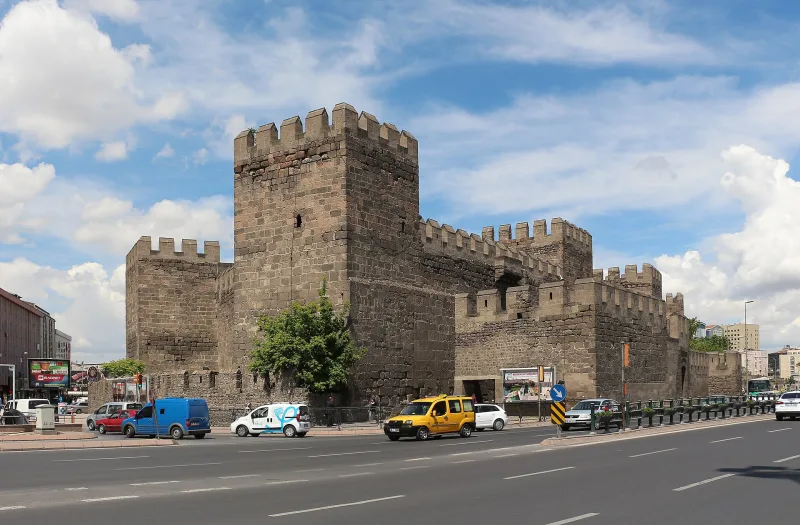
In the very center of Kayseri, at the foot of Mount Erciyes, stands a gloomy and incredibly imposing fortress made of dark basalt—Kayseri Kalesi. Its 18 rectangular towers and double ring of walls bear witness to Roman coin minters, Justinian with his slender yet sturdy curtain walls, the Seljuk sultan Alaeddin Keykubad I, and the Ottomans, who transformed the citadel into a residential quarter for 600 families. Today, following restoration, the inner courtyard has become a public space, while the walls remain a living textbook of Anatolian fortification.
History of the Fortress
The earliest records of the city walls of Kayseri (then the Roman city of Caesarea in Cappadocia) come from coins dating to the reign of Emperor Gordian III (238–244). In the 6th century, Emperor Justinian I carried out a major reconstruction: he narrowed the perimeter, making the fortification more compact and easier to defend. This layout largely determined the outline of the inner citadel, which is still visible today.
A decisive stage in the fortress’s history is linked to the Seljuk era. In 1224, Sultan Alaeddin Keykubad I carried out a large-scale reconstruction—a marble inscription records the completion of the work in the year 621 of the Hijra (1224). It was during the Seljuk period that the familiar appearance of dark basalt with rectangular towers took shape.
Later, the fortress passed to the Karamanids and then to the Ottomans, undergoing repeated repairs. Under Mehmed II the Conqueror in the 15th century, a small mosque—Kale Camii—was built inside the fortress. Over time, its military function faded, and the inner courtyard transformed into a densely populated residential quarter, where, according to various sources, up to 600 families lived in the 19th century. In the 20th century, the buildings inside were gradually vacated; at the beginning of the 21st century, a comprehensive restoration was carried out, and the fortress was opened to residents and tourists.
Architecture and What to See
Walls and towers
The inner citadel has an elongated layout: approximately 800 meters from north to south and 200 meters from east to west. There are 18–19 rectangular towers along the perimeter. The walls are built primarily of dark basalt quarried on the slopes of Mount Erciyes; the masonry is dense, with regular bonding and the characteristic “dovetail joints” of the Seljuk era.
Gates
The main gates are the southern and eastern ones. Above the southern entrance, fragments of inscriptions and stone carvings typical of the Seljuk decorative school have been preserved. The outer ring of fortifications has survived only in fragments to the present day: most of it was dismantled in the 19th–20th centuries during the city’s expansion.
Kale Camii
Inside the courtyard stands a small mosque, founded by Mehmed II the Conqueror in the 15th century. Its modest architecture is a characteristic example of the early Ottoman provincial style.
Seljuk Inscription
The main epigraphic treasure is a marble inscription from 1224, documenting repairs carried out under Alaeddin Keykubad I. This is one of the key documents of the Seljuk fortification program in Central Anatolia.
Interesting facts
- Kayseri Castle is one of the few large fortresses in Turkey built entirely of black volcanic basalt; the material was brought from the slopes of Mount Erciyes.
- In the 19th century, up to 600 residential courtyards were located within the walls—the fortress functioned as a full-fledged urban neighborhood rather than a military facility.
- In 1224, the Seljuks rebuilt the fortress as part of a major program to fortify Anatolian cities in response to the Mongol threat—work was carried out simultaneously in Konya, Sivas, and other centers.
- The Kale Camii mosque inside the courtyard is still in use today.
- Following restoration in the early 2010s, the fortress’s inner courtyard became a public space featuring benches, cafes, and artisan galleries.
How to get there
The fortress is located in the very center of Kayseri, next to Cumhuriyet Meydanı Square, the Hunat Hatun Mosque, and the covered bazaar. Coordinates: 38°43′12″ N, 35°29′24″ E. From any transportation hub in the city, it takes no more than 10–15 minutes to walk to the fortress.
The nearest airport is Kayseri Erkilet (ASR), about 7 km from the city center; the Kayseray tram line and buses run from there. From other cities, take the YHT high-speed train or a bus. Within Kayseri, the tram is a convenient option: the nearest stop is Cumhuriyet Meydanı, a two-minute walk from the fortress walls.
Tips for travelers
The best time to visit is late spring and early fall. In winter, Kayseri is cold and often snowy (the Erciyes ski resort is nearby), while in summer it is hot and dry. The basalt walls get very hot, and there is little shade.
Allow 1–1.5 hours for the fortress and the same amount of time for the neighboring Hunat Hatun complex (a 13th-century mosque, madrasa, khanqah, and hamam) and the Grand Bazaar. This is one of the most concentrated districts of Seljuk heritage in Turkey.
Comfortable shoes are a must: the cobblestones inside the fortress are uneven, and the staircases up to the walls are steep. Following restoration, some of the spaces have been allocated to artisans—here you can view and purchase local textiles and metalwork, bypassing chain stores.
Photographers should shoot in the morning, when the eastern walls are lit by side light, or in the evening, when the fortress is illuminated. Black basalt looks best in contrasting light; on cloudy days, the walls appear too flat.